Ads Media: Strategy Guide for 2026 Digital Marketing

The advertising landscape has transformed dramatically over the past decade, with ads media evolving from simple banner placements to sophisticated, multi-channel ecosystems that demand strategic expertise and technical precision. As we navigate through 2026, businesses face an increasingly complex environment where connected television, retail media networks, and programmatic platforms compete for attention alongside traditional social and search channels. Understanding how to navigate this fragmented yet interconnected ads media ecosystem has become essential for brands seeking to maximise return on investment whilst maintaining brand safety and measurement accuracy.
The Modern Ads Media Landscape
Ads media today encompasses far more than the display banners and search listings that dominated digital marketing a decade ago. The ecosystem now spans connected TV (CTV), streaming platforms, retail media networks, social video, and emerging formats that blur the lines between content and commerce.
According to WARC’s latest forecasts, global ad market growth is projected at 8.9% through 2026, with significant concentration occurring within Big Tech platforms. This consolidation creates both opportunities and challenges for advertisers who must balance reach with diversification.
Classification and Taxonomy
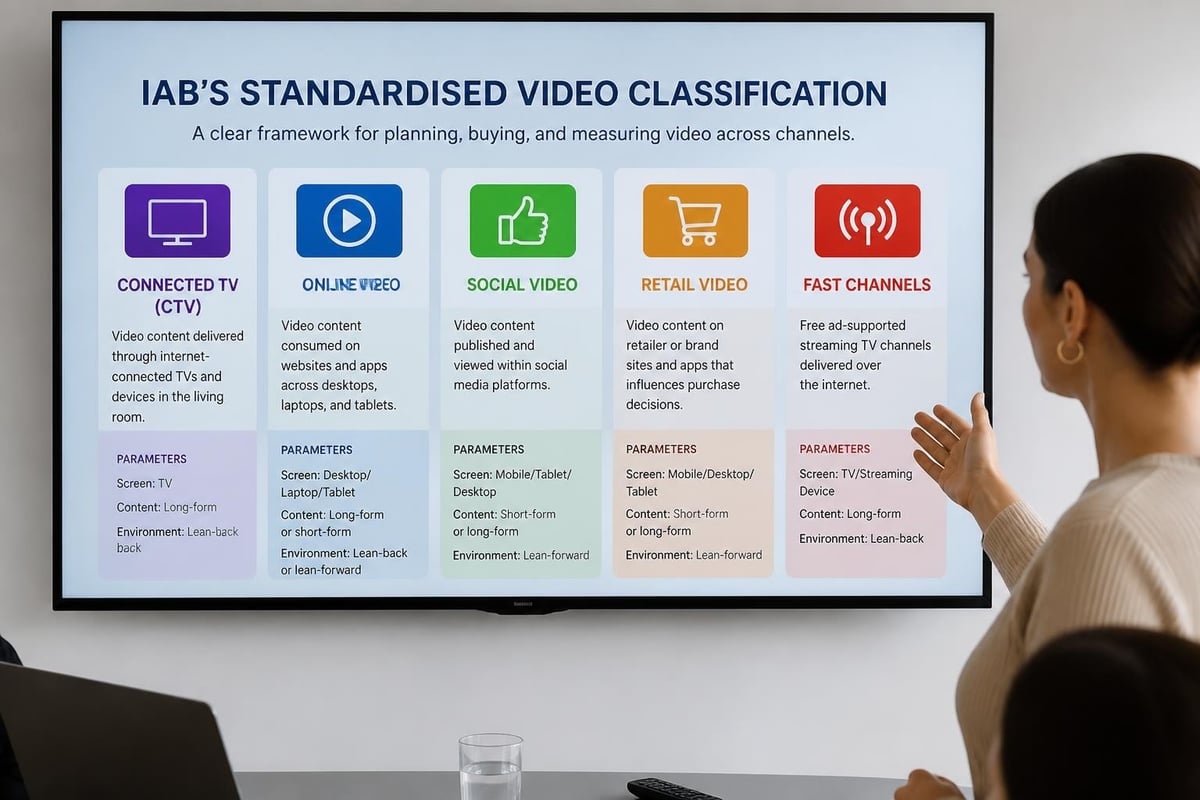
One of the fundamental challenges facing ads media strategists is the lack of standardised definitions across platforms. The IAB’s redefining media types framework proposes a modern classification system that standardises how we categorise video and media types across CTV, online video, social video, retail video, and FAST (free ad-supported streaming television).
This standardisation matters because:
- Measurement consistency requires common definitions across platforms
- Budget allocation depends on comparing like-for-like performance
- Cross-platform strategies need unified taxonomy to function effectively
- Reporting accuracy relies on consistent classification methods
Without agreed-upon standards, advertisers risk comparing apples to oranges when evaluating channel performance, leading to misallocated budgets and missed opportunities.
Emerging Ad Formats Reshaping the Industry
The ads media landscape continues to expand with innovative formats that extend beyond traditional pre-roll and display placements. These new formats offer fresh opportunities for engagement whilst presenting measurement challenges.
Connected TV Ad Innovation
IAB Tech Lab’s CTV Ad Portfolio provides detailed specifications for emerging formats that are transforming how audiences interact with advertising on streaming platforms. These include:
| Format Type | Description | Best Use Case |
|---|---|---|
| Pause Ads | Displayed when viewers pause content | High engagement moments with captive attention |
| Menu Ads | Integrated into platform navigation | Brand awareness during browsing sessions |
| Overlay Ads | Non-intrusive banners during playback | Maintaining content flow whilst delivering messages |
| Screen Saver Ads | Displayed during idle periods | Extended exposure for brand recall |
These formats represent a significant evolution in ads media strategy, moving beyond interruption-based models toward contextual integration that respects the viewing experience.
Programmatic Advances
Programmatic advertising has matured considerably, with sophisticated targeting capabilities and automated optimisation becoming standard across ads media channels. The CTV programmatic guide outlines critical standards around ad product taxonomy, audience taxonomy, content tagging, and programmatic practices that enable precise targeting whilst maintaining transparency.
Programmatic now accounts for the majority of digital display spending, with automation extending into traditional strongholds like direct publisher relationships. This shift requires advertisers to develop new competencies around data management, algorithmic bidding, and cross-platform attribution.
Performance Benchmarking Across Channels
Understanding what constitutes strong performance varies significantly across ads media channels. Tinuiti’s Q4 2025 benchmark report provides valuable insights into performance metrics across search, social, retail, and display advertising.
Key Performance Indicators by Channel
Search Advertising
- Cost-per-click (CPC) trends showing moderate inflation
- Conversion rates stabilising after pandemic volatility
- Quality Score importance increasing with auction competition
Social Media Advertising
- CPM fluctuations driven by inventory changes
- Video formats outperforming static creative
- Story placements gaining share of budget
Retail Media Networks
- Higher conversion rates due to purchase intent
- Growing inventory across major e-commerce platforms
- Attribution challenges with closed-loop ecosystems
For businesses investing in ads media, establishing baseline metrics specific to their industry and objectives is crucial. Generic benchmarks provide context, but performance must be evaluated against business outcomes rather than vanity metrics.

Strategic Considerations for Ads Media Investment
Developing an effective ads media strategy requires balancing multiple factors including audience reach, engagement quality, measurement capabilities, and budget efficiency. The fragmentation of media consumption patterns means that single-channel strategies rarely deliver optimal results.
Audience Targeting and Segmentation
Modern ads media platforms offer unprecedented targeting capabilities, from demographic and geographic parameters to behavioural and contextual signals. However, this precision comes with privacy considerations and regulatory constraints that continue to evolve.
Effective targeting strategies in 2026 must account for:
- Cookie deprecation and alternative identity solutions
- First-party data activation and enrichment
- Contextual targeting resurgence alongside behavioural methods
- Privacy-compliant audience building and suppression
Businesses should prioritise building first-party data assets whilst developing contextual strategies that perform in privacy-first environments.
Budget Allocation Frameworks
The Sensor Tower State of Digital Advertising report provides cross-channel insights into U.S. ad spend, revealing how leading advertisers distribute budgets across OTT, retail media, social advertising, and traditional digital channels.
Rather than following industry averages blindly, smart allocation requires:
- Testing across channels to understand relative efficiency
- Incrementality measurement to identify true performance drivers
- Customer journey mapping to allocate based on touchpoint influence
- Competitive analysis to identify underutilised opportunities
- Seasonal adjustment to match budget with demand cycles
Many businesses benefit from working with specialists who understand these nuances. For instance, comprehensive digital marketing services can help navigate channel selection and optimisation based on specific business objectives rather than generic best practices.
Brand Safety and Verification Challenges
As ads media expands across programmatic channels and user-generated content platforms, brand safety has emerged as a critical concern. The IAS 2025 Industry Pulse Report highlights campaigns' key challenges, from ad fraud and brand safety to measurement issues and cross-device attribution.
Classification Inconsistencies
Research published in early 2026 on inconsistencies in classification of online news articles reveals how brand safety providers differ significantly in classifying content. This variation creates risk for advertisers who may inadvertently appear alongside unsuitable content despite verification tools.
Mitigating these risks requires:
- Multiple verification layers rather than relying on single vendors
- Allowlist and blocklist management with regular review cycles
- Contextual suitability settings that go beyond basic safety parameters
- Post-campaign auditing to verify placement quality
The stakes are particularly high for premium brands where a single misplacement can generate negative publicity that outweighs campaign benefits.
Fraud Prevention
Ad fraud remains a persistent challenge across ads media channels, with sophisticated bot networks and domain spoofing continuing to drain budgets. Effective fraud prevention combines pre-bid filtering, in-flight monitoring, and post-campaign analysis to identify and eliminate fraudulent inventory.

Creative Excellence in Ads Media
While targeting and placement receive significant attention, creative quality remains the largest performance driver in ads media campaigns. Even perfectly targeted, fraud-free placements fail when creative doesn't resonate with audiences.
Format-Specific Creative Strategies
Different ads media channels demand different creative approaches:
| Channel | Creative Requirements | Key Success Factors |
|---|---|---|
| CTV | High production value, sound-on viewing | Strong opening hook, brand integration |
| Social Video | Mobile-optimised, sound-off capable | Visual storytelling, text overlays |
| Display | Multiple size variations, fast loading | Clear value proposition, strong CTA |
| Native | Editorial style, contextual relevance | Authentic voice, value-first approach |
| Retail Media | Product-focused, purchase-driving | Clear benefits, competitive positioning |
Creative testing should be systematic rather than ad hoc, with structured variation in messaging, visual approach, and call-to-action to identify performance drivers.
Dynamic Creative Optimisation
Advanced ads media platforms now support dynamic creative optimisation (DCO), automatically assembling ad components based on audience signals and performance data. This technology enables personalisation at scale whilst maintaining creative quality standards.
DCO works best when:
- Creative assets are modular and designed for recombination
- Data feeds enable real-time personalisation triggers
- Brand guidelines ensure consistency across variations
- Performance tracking attributes results to specific elements
Measurement and Attribution Complexity
As customer journeys span multiple touchpoints across ads media channels, attribution has become increasingly complex. Traditional last-click models undervalue upper-funnel activities, whilst multi-touch attribution models require sophisticated implementation and ongoing calibration.
Cross-Device Challenges
Modern consumers move seamlessly between devices, creating measurement gaps when attribution systems can't connect interactions. Privacy changes have made deterministic device graphing more difficult, forcing greater reliance on probabilistic methods with inherent accuracy limitations.
Solutions include:
- First-party login environments that enable cross-device tracking
- Incrementality testing to understand channel contribution independent of attribution
- Media mix modelling for aggregate impact assessment
- Unified measurement frameworks that combine multiple methodologies
Platform-Specific Walled Gardens
Major ads media platforms increasingly operate as walled gardens with proprietary measurement systems that don't easily integrate with cross-platform analytics. This fragmentation makes holistic performance evaluation challenging and can obscure true efficiency comparisons.
Advertisers should demand transparency whilst building independent measurement capabilities that provide platform-agnostic insights into campaign contribution and audience overlap.
Integration with Broader Marketing Ecosystems
Ads media doesn't operate in isolation but must integrate with owned channels, organic visibility, and offline activities to create cohesive customer experiences. This integration requires strategic coordination across multiple disciplines.
For example, businesses investing in web design need to ensure their landing pages align with ads media messaging and provide seamless conversion paths. Disconnects between advertising promises and website experiences waste media investment and damage conversion rates.
Similarly, organic search visibility through SEO creates a foundation that reduces reliance on paid channels for high-intent queries. When paid and organic strategies align, businesses achieve greater overall visibility whilst improving cost efficiency.
Content and Commerce Convergence
The boundaries between content, commerce, and advertising continue to blur, with shoppable video, live-stream commerce, and social storefronts creating new ads media formats that integrate purchasing directly into the ad experience.
This convergence particularly benefits brands with strong visual products or experiential offerings. For businesses in sectors like custom audio-visual installations, partnering with specialists such as ANR media for high-quality presentation materials ensures that products showcase effectively within these commerce-enabled ad formats.
Regional and Platform-Specific Considerations
Ads media strategies must account for significant regional variations in platform dominance, audience behaviour, and regulatory environment. What works brilliantly in one market may fail completely in another.
Platform Evolution and Emerging Channels
The platform landscape continues to evolve rapidly, with established players adding new ad products whilst emerging platforms create fresh opportunities:
- Short-form video platforms expanding e-commerce integration
- Audio streaming services developing sophisticated ad targeting
- Gaming environments opening premium inventory for non-endemic brands
- Metaverse experiences experimenting with immersive ad formats
Early adoption of emerging channels can deliver exceptional efficiency before competition intensifies and pricing normalises. However, this must be balanced against platform risk, measurement maturity, and audience scale.
Regulatory Compliance
Different jurisdictions impose varying requirements around data usage, creative disclosures, and audience targeting. Ads media campaigns operating across multiple regions must ensure compliance with the strictest applicable standards whilst optimising within permitted boundaries.
Key regulatory considerations include:
- GDPR compliance for European audiences
- Children's privacy protections across jurisdictions
- Health and financial services advertising restrictions
- Political advertising transparency requirements
- Gambling and age-restricted product regulations
Optimisation Methodology and Testing Frameworks
Continuous optimisation separates high-performing ads media programmes from mediocre ones. This requires structured testing methodologies, rigorous analysis, and disciplined implementation of learnings.
Statistical Rigour in Testing
Too many ads media tests draw conclusions from insufficient data or confounded variables. Proper testing requires:
- Clear hypothesis formation before test launch
- Adequate sample sizes for statistical significance
- Controlled variables isolating the tested element
- Sufficient duration to account for weekly patterns
- Documented learnings for institutional knowledge building
Even small improvements compound over time when systematically tested and implemented across campaigns.
Automation and Machine Learning
Modern ads media platforms incorporate increasing levels of automation and machine learning, from bid optimisation to creative selection. Whilst these systems can improve efficiency, they require proper configuration, sufficient data volumes, and ongoing monitoring to perform optimally.
Advertisers should understand the trade-offs between manual control and automated optimisation, gradually expanding automation as confidence and data quality increase.
The complexity of today's ads media landscape demands strategic expertise, technical precision, and continuous adaptation to evolving platforms and audience behaviours. Success requires balancing innovation with proven fundamentals, testing new opportunities whilst optimising established channels, and maintaining measurement discipline amidst fragmentation. Whether you're looking to launch your first digital advertising campaign or optimise an established ads media programme, OxD PR combines deep platform expertise with strategic marketing acumen to drive measurable business results across the full spectrum of digital channels.