Marketing Agency Advertising: Strategies That Convert

Marketing agency advertising represents one of the most challenging paradoxes in the business world: experts who excel at promoting client brands often struggle to market their own services effectively. The competitive landscape in 2026 demands that agencies not only deliver exceptional results for clients but also showcase their capabilities through strategic, multi-channel advertising approaches. For digital marketing consultancies like OxD PR, understanding how to position services, demonstrate value, and build trust through advertising becomes essential for sustainable growth and market differentiation.
Understanding the Marketing Agency Advertising Landscape
The advertising ecosystem for marketing agencies differs fundamentally from traditional product-based businesses. Agencies sell expertise, relationships, and measurable outcomes rather than tangible goods. This creates unique challenges in how services are packaged and promoted.
Successful marketing agency advertising requires demonstrating authority whilst simultaneously proving ROI potential. Prospective clients don't simply want to see creative campaigns; they need evidence of strategic thinking, industry knowledge, and proven methodologies that drive business growth.
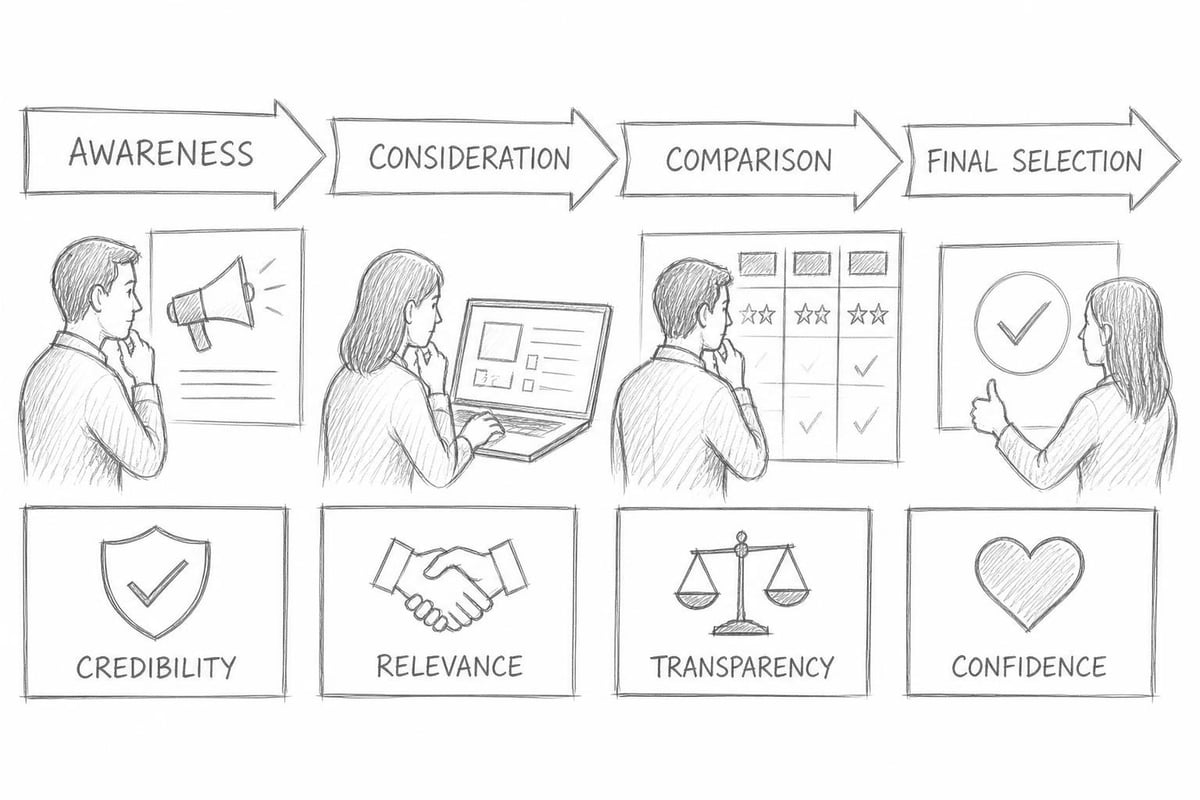
The Trust Factor in Agency Selection
Trust remains the cornerstone of effective marketing agency advertising. According to research on advertising agency website design, clarity and creativity must work together to establish credibility immediately. Agencies must answer three fundamental questions through their advertising:
- Can they understand my specific business challenges?
- Have they delivered results for companies similar to mine?
- Will they communicate transparently throughout our partnership?
Building this trust requires consistent messaging across all touchpoints, from initial discovery through to client onboarding. The most effective marketing agency advertising doesn't oversell services but instead educates prospects on what realistic success looks like.
Strategic Positioning Through Specialized Services
Generic "full-service" positioning has become increasingly ineffective in marketing agency advertising. The market rewards specialists who demonstrate deep expertise in specific verticals or service areas. Agencies that communicate clear specialization attract higher-quality leads with better budget alignment.
Effective positioning strategies include:
- Industry vertical specialization (e.g., healthcare, fintech, e-commerce)
- Service-specific expertise (SEO, paid acquisition, conversion optimization)
- Outcome-based positioning (revenue growth, lead generation, brand awareness)
- Technology platform mastery (HubSpot partners, Shopify experts)
For consultancies offering comprehensive solutions, the challenge becomes balancing breadth with perceived depth. The solution lies in developing creative strategy frameworks that showcase how integrated services work together whilst highlighting specific areas of excellence.
Crafting Your Unique Value Proposition
Your value proposition forms the foundation of all marketing agency advertising efforts. This statement must articulate what makes your approach different, better, or more suitable for specific client segments. Generic claims about "results-driven strategies" or "cutting-edge solutions" fail to differentiate.
| Weak Positioning | Strong Positioning |
|---|---|
| "We deliver results" | "We increase SaaS trial-to-paid conversions by 40% within 90 days" |
| "Full-service digital marketing" | "Performance marketing for DTC brands scaling from £500K to £5M revenue" |
| "Award-winning creativity" | "Brand positioning that commands 30% premium pricing in competitive markets" |
Notice how strong positioning includes specificity around outcomes, timeframes, and target audiences. This precision attracts ideal clients whilst naturally filtering out poor-fit prospects who would drain resources.
Content Marketing as Agency Advertising
Content remains the most powerful long-term investment in marketing agency advertising. While paid channels deliver immediate visibility, strategic content builds compounding authority that reduces acquisition costs over time. The most effective agencies treat their content operations as seriously as client deliverables.
Publishing consistently on digital marketing tactics establishes thought leadership whilst creating multiple entry points for prospects at different awareness stages. Educational content answers questions before they're asked, building trust and demonstrating expertise simultaneously.
Content Formats That Convert Prospects
Different content types serve distinct purposes in the prospect journey. Effective marketing agency advertising leverages this variety strategically:
- Long-form guides: Demonstrate comprehensive knowledge and improve search visibility
- Case studies: Provide social proof and outcome evidence
- Video tutorials: Build personal connection and showcase process transparency
- Industry research: Position the agency as a knowledge authority
- Tool comparisons: Capture high-intent search traffic
The key lies in distribution strategy. Creating exceptional content means nothing without systematic promotion through owned, earned, and paid channels. Agencies should allocate 20% of time to creation and 80% to promotion and repurposing.
Paid Advertising Channels for Agency Growth
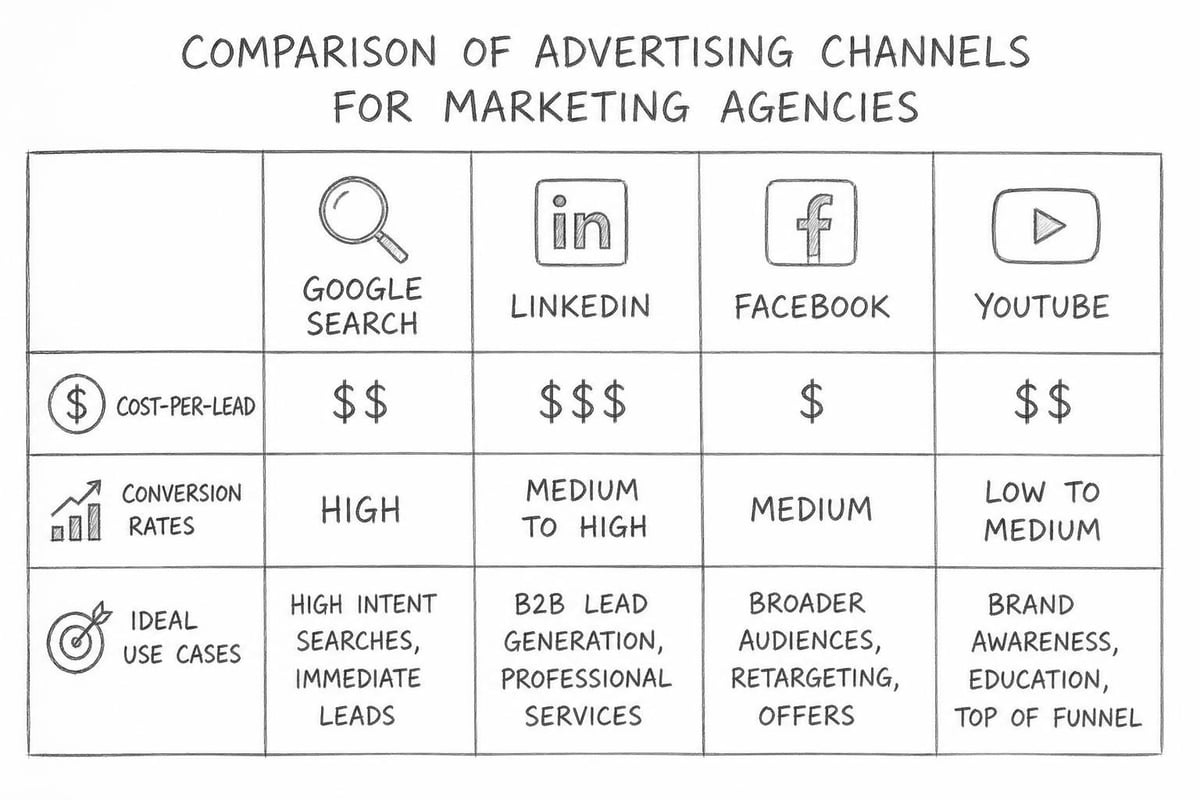
While organic strategies build long-term equity, paid marketing agency advertising delivers predictable lead flow necessary for planning and growth. The challenge becomes selecting channels that align with prospect behaviour and budget realities.
Google Search Ads remain highly effective for capturing high-intent queries like "SEO agency London" or "B2B content marketing consultancy." The commercial intent behind these searches justifies higher cost-per-click rates. Focus on service-specific landing pages rather than generic homepage destinations.
LinkedIn Advertising excels for B2B agency services targeting specific job titles, company sizes, or industries. Account-based marketing approaches using LinkedIn's targeting capabilities allow personalized messaging to key decision-makers. However, costs require careful campaign structure and regular optimization.
Retargeting and Nurture Sequences
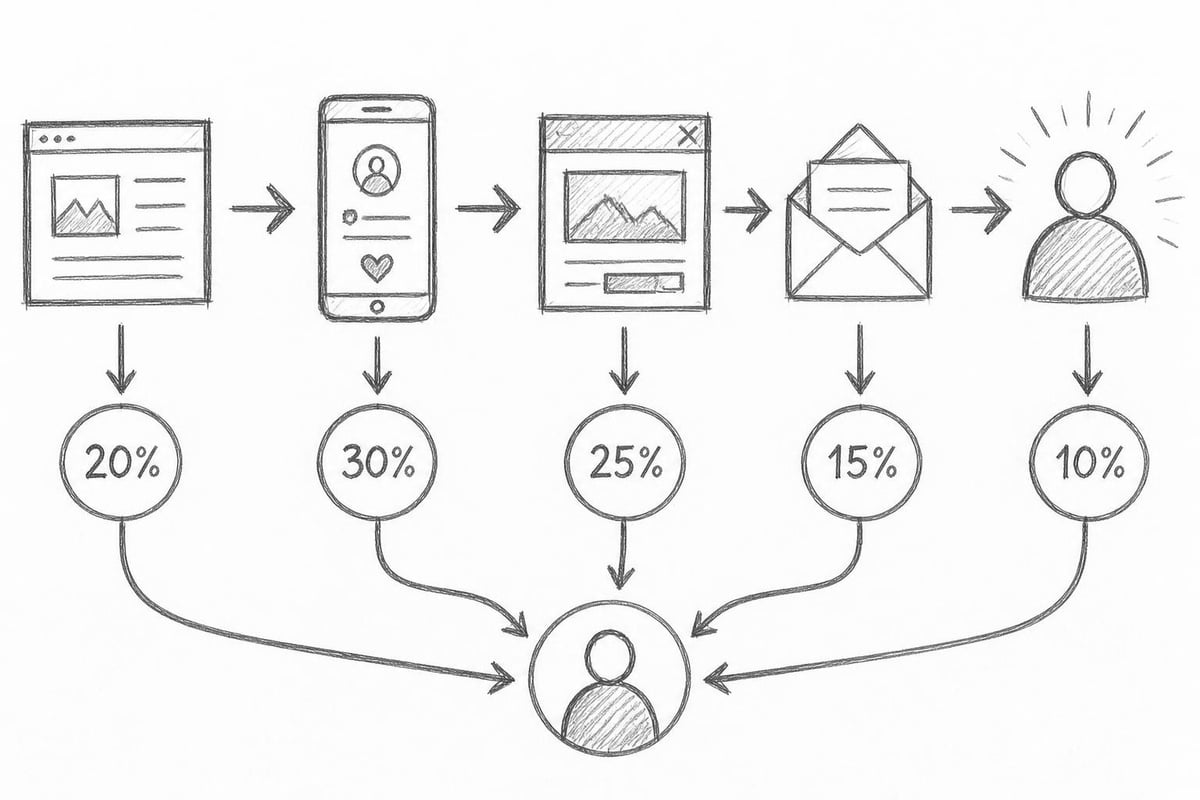
Most agency prospects require multiple touchpoints before engagement. Retargeting campaigns keep your services visible as prospects continue research and evaluation. Effective marketing agency advertising sequences might include:
- Initial website visit triggers awareness-stage content
- Second visit within 7 days shows case study relevant to their industry
- Third visit presents specific service offering with clear CTA
- Extended sequences introduce testimonials and process explanations
This approach respects the considered nature of agency selection whilst maintaining visibility throughout the decision journey. Integration with email nurture sequences creates cohesive multi-channel experiences.
Social Proof and Trust Signals
Marketing agency advertising must overcome natural scepticism about promised results. Social proof provides the evidence that transforms interest into action. The most persuasive agencies systematically collect and showcase proof points across all advertising touchpoints.
Best practices for client reporting also apply to public-facing results communication. Specific metrics, attribution context, and honest timeframes build credibility that vague success claims cannot match.
Types of Social Proof That Drive Conversions
| Proof Type | Impact Level | Implementation Ease |
|---|---|---|
| Video testimonials | Very High | Moderate |
| Quantified case studies | Very High | Moderate |
| Industry awards | Moderate | Variable |
| Client logos | Low-Moderate | Easy |
| Team credentials | Moderate | Easy |
| Review platform ratings | High | Easy |
Video testimonials carry exceptional weight because they're difficult to fabricate and showcase genuine client relationships. Investing in professional production for 3-5 anchor testimonials provides material for multiple advertising applications.
For agencies working with enterprise clients, securing permission to publicly reference relationships proves challenging. Solutions include anonymized case studies ("Global Fintech Platform" rather than specific names) or private reference calls for qualified prospects.
Optimizing Your Agency Website for Conversion
Your website serves as the central hub for all marketing agency advertising efforts. Every channel ultimately directs prospects to your digital presence for evaluation. Yet many agency sites prioritise aesthetic appeal over conversion architecture.
The new website deal approach recognizes that effective sites balance visual impact with clear service communication and low-friction conversion paths. Prospects should understand your specialization, see relevant proof points, and know exactly how to engage within 30 seconds.
Essential conversion elements include:
- Clear primary service positioning above the fold
- Industry-specific or outcome-based navigation
- Prominent case studies with quantified results
- Multiple conversion opportunities at varying commitment levels
- Fast load times and mobile optimization
- Trust indicators (certifications, partnerships, reviews)
Many agencies fall into the "portfolio trap," showcasing creative work without explaining business impact. Effective marketing agency advertising through your website connects creative execution to client outcomes consistently.
Lead Magnet Strategy for Nurture Building
Contact forms requesting immediate consultations create unnecessary friction. Lead magnets provide value in exchange for contact information, enabling nurture sequences that educate whilst building trust. Resources tailored to specific prospect segments perform better than generic guides. A top digital marketing websites guide targets different prospects than a conversion rate optimization checklist.
Consider developing assessment tools, calculators, or audit frameworks that provide personalized insights. These interactive experiences demonstrate methodology whilst qualifying lead quality through response data.
Partnership and Referral Marketing
Strategic partnerships represent underutilized channels in marketing agency advertising. Complementary service providers, technology platforms, and industry associations offer access to qualified audiences with established trust.
Partnership models worth exploring:
- Technology partnerships: Platform vendors (Shopify, HubSpot) seeking certified implementation partners
- Service complementarity: Web development agencies partnering with specialized SEO firms
- Industry associations: Speaking opportunities and member directories in relevant sectors
- Outsourcing arrangements: Companies like Focus Services that require marketing support for their clients
Referral programmes from existing clients often deliver the highest quality leads. Systematic approaches to requesting introductions and testimonials convert satisfied clients into active advocates. Consider implementing structured referral incentives that reward both parties appropriately.
Measuring Marketing Agency Advertising Effectiveness
Attribution complexity increases when selling high-consideration services through multiple touchpoints. Effective measurement requires tracking both leading indicators (traffic, engagement) and lagging outcomes (qualified leads, new clients). The challenge lies in connecting these metrics meaningfully.
Key performance indicators for agency advertising:
- Cost per qualified lead (CPQL): Total advertising spend divided by leads meeting ICP criteria
- Lead-to-client conversion rate: Percentage of qualified leads becoming clients
- Customer acquisition cost (CAC): Total marketing and sales costs per new client
- Time-to-close: Average duration from first touch to signed agreement
- Client lifetime value (LTV): Average revenue per client across relationship duration
The LTV:CAC ratio determines sustainable growth potential. Ratios above 3:1 indicate healthy unit economics that support scaling advertising investment. Understanding social media advertising foundations helps agencies apply these metrics across platforms effectively.
Ethical Considerations in Agency Advertising
The advertising industry faces increasing scrutiny around truthfulness and transparency. Agencies must hold themselves to standards they'd expect from clients. Research on microtargeting ethics and transparency in affiliate marketing highlights the importance of honest communication in digital advertising.
Avoid these common pitfalls in marketing agency advertising:
- Guaranteeing specific rankings or traffic numbers
- Showcasing client work without proper attribution or permission
- Exaggerating team size or capabilities
- Using stock photography presented as actual client outcomes
- Hiding pricing until deep in sales conversations
Building a reputation for transparency creates competitive advantage. Prospects tired of overselling appreciate honest communication about timelines, investment requirements, and realistic expectations. This approach may filter out some leads but dramatically improves close rates among qualified prospects.
Emerging Trends Shaping Agency Advertising
The marketing agency advertising landscape continues evolving with technological advancement and changing buyer behaviour. Staying ahead of these shifts creates opportunities for early adopters whilst helping avoid obsolete tactics.
AI and automation increasingly impact both service delivery and how agencies advertise. Prospects expect agencies to leverage these tools for efficiency whilst maintaining strategic oversight. Showcasing your AI integration demonstrates forward-thinking approaches that appeal to innovation-focused clients.
Video-first content dominates engagement across platforms. Agencies comfortable appearing on camera and producing consistent video content gain visibility advantages. Short-form video through LinkedIn, YouTube Shorts, and other platforms provides high-reach opportunities at relatively low production costs.
Community building emerges as a differentiation strategy. Agencies hosting valuable communities (Slack groups, LinkedIn groups, regular webinars) position themselves as connectors and knowledge hubs rather than just service providers. This approach aligns with strategies for promoting advertising agencies through relationship-focused methods.
The shift toward outcome-based pricing models affects how agencies communicate value. Moving beyond hourly rates or monthly retainers toward performance-based arrangements requires different marketing agency advertising approaches that emphasize accountability and shared success.
Effective marketing agency advertising combines strategic positioning, multi-channel execution, and systematic measurement to attract ideal clients consistently. By demonstrating expertise through valuable content, leveraging social proof strategically, and maintaining transparency throughout the prospect journey, agencies build sustainable growth engines. If you're ready to enhance your digital presence with proven strategies that drive real results, OxD PR combines technical expertise with creative execution to help businesses stand out in competitive markets and achieve measurable growth.