7 Game-Changing Creative Advertising Agency Ideas for 2026
The world of advertising is evolving at a pace never seen before, with technology and consumer expectations reshaping the industry every year. For any creative advertising agency determined to thrive in 2026, staying ahead of these shifts is essential.
This article reveals seven innovative ideas set to redefine what it means to be a creative advertising agency in the coming years. From harnessing AI-driven creativity and immersive brand experiences to championing sustainability, these strategies are designed to inspire and empower.
Discover what’s next, build your agency’s competitive edge, and be ready to implement the most impactful trends shaping the future.
The Evolution of Creative Advertising Agencies in 2026
The creative advertising agency landscape is undergoing a dramatic transformation as 2026 approaches. Agencies must adapt rapidly to meet new expectations, leverage technology, and deliver meaningful value to both clients and consumers. Understanding these shifts is essential for any creative advertising agency aiming to remain competitive.

Shifting Client Expectations and Hyper-Personalisation
Clients now expect creative advertising agency partners to deliver campaigns that speak directly to their audiences. Personalisation is no longer optional; it is the standard. In fact, 78% of CMOs list personalisation as a top priority for their 2026 strategies.
To meet these demands, agencies are harnessing advanced analytics and AI-powered tools. This enables the tailoring of content to individual tastes and behaviours, transforming how brands connect with consumers. For deeper insights on modern approaches, see Advertising agency marketing strategies.
Integration of Technology and Human Creativity
A creative advertising agency must balance automation with authentic creative direction. AI now supports ideation, generating initial concepts or mood boards. However, human teams remain essential for refining these ideas, ensuring campaigns align with brand voice and core values.
For example, agencies use AI to propose hundreds of campaign variations, while creative directors curate and perfect the final message. This synergy elevates the quality and uniqueness of every campaign.
The Importance of Omnichannel Experiences
Modern consumers interact with brands across many platforms. Creative advertising agencies are challenged to create seamless experiences that span digital, social, physical, and emerging channels.
A successful omnichannel approach ensures that messaging, visuals, and tone remain consistent. Brands employing AR in both retail and social media demonstrate how integration enhances engagement and brand recall.
Data-Driven Decision Making
Data now drives every decision within a creative advertising agency. Real-time analytics enable agencies to optimise campaigns while they run, quickly responding to audience feedback and market trends.
Predictive analytics are particularly valuable, allowing agencies to forecast what will resonate and adjust strategies accordingly. This results in more effective campaigns and improved return on investment.
Sustainability and Social Responsibility
Sustainability is increasingly vital for any creative advertising agency. Brands and their partners are expected to prioritise environmental and ethical considerations at every stage.
Recent research shows 62% of consumers prefer brands that demonstrate visible sustainability initiatives. This shift challenges agencies to integrate purpose-driven messaging and eco-friendly practices into their work.
The Rise of Niche and Boutique Agencies
The market has become crowded, leading to a rise in specialised creative advertising agencies. These boutique firms focus on specific sectors or creative approaches, offering expertise that larger, generalist agencies may lack.
Clients value the deep industry knowledge and tailored service these agencies provide. Specialisation has become a key differentiator in winning and retaining accounts.
Demand for End-to-End Solutions
Clients increasingly seek a creative advertising agency that provides a full spectrum of services. From strategy and creative to media buying, analytics, and technology, agencies that offer end-to-end solutions are outperforming single-discipline firms in client retention.
This comprehensive approach ensures consistency, efficiency, and measurable results. As the industry continues to evolve, agencies that adapt to these expectations will set the pace for future success.
7 Game-Changing Creative Advertising Agency Ideas for 2026
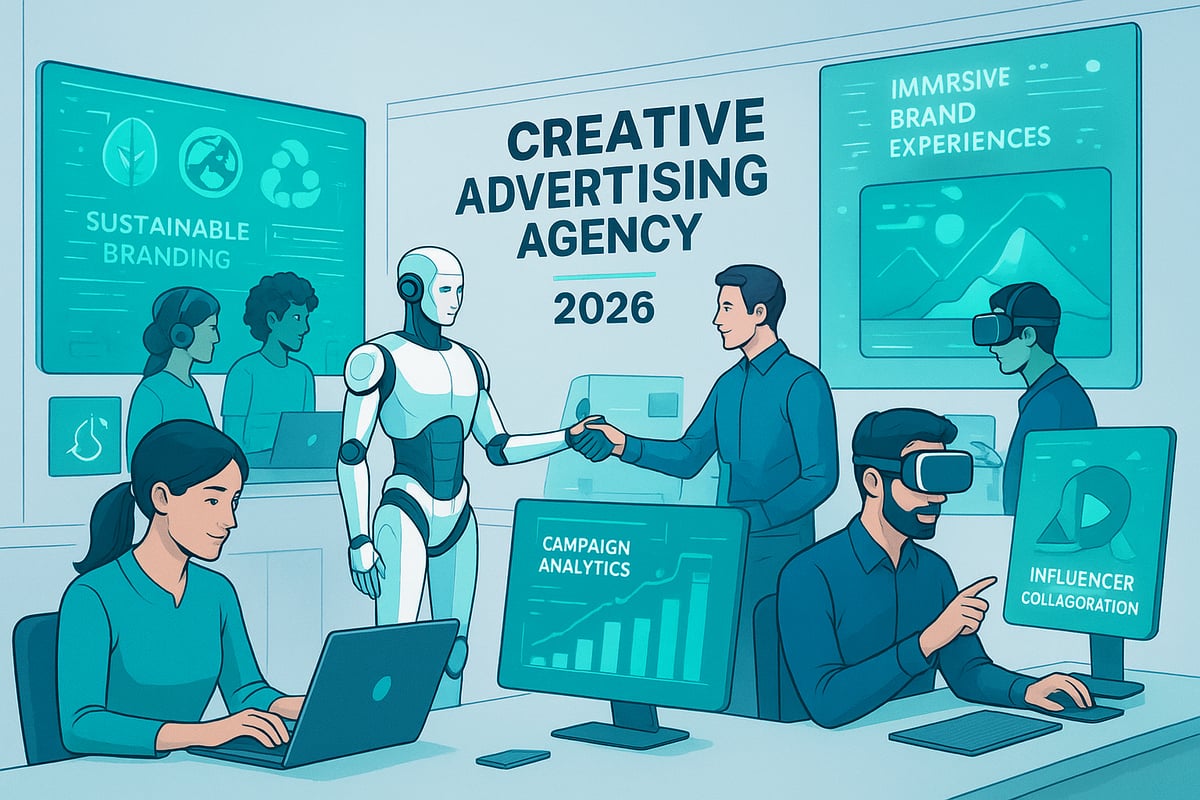
The world of creative advertising agency work is being redefined in 2026. Agencies are embracing new technologies, data-driven strategies, and innovative partnerships to deliver standout campaigns. Below, we explore seven transformative ideas every creative advertising agency should consider to stay ahead in this dynamic landscape.
1. AI-Driven Creative Concept Development
Artificial intelligence is transforming how creative advertising agency teams brainstorm and develop concepts. Today, generative AI tools can produce mood boards, draft copy, and even edit video content, speeding up ideation and expanding creative horizons.
For instance, agencies now use platforms like Midjourney, Jasper, and Adobe Sensei to generate hundreds of ideas in minutes. AI drafts the framework, while human creatives refine messaging and ensure campaigns align with a brand’s unique voice. This synergy allows agencies to deliver highly personalised content at an unprecedented pace.
However, adopting AI does raise challenges. Agencies need to maintain brand consistency and address ethical concerns around AI-generated content. Striking the right balance between automation and human oversight is crucial.
A recent case study highlighted an agency that, by integrating AI, increased its campaign concepts output by 300 percent while halving development time. This approach allows a creative advertising agency to offer more value and adaptability to clients.
For a deeper dive into how AI is reshaping agency workflows and client expectations, see AI transforming marketing agencies. Embracing AI is no longer optional; it is essential for any forward-thinking creative advertising agency.
2. Immersive Brand Experiences with AR and VR
Immersive technologies are revolutionising the way audiences interact with brands. In 2026, a creative advertising agency leverages augmented reality (AR) and virtual reality (VR) to create memorable, interactive campaigns that drive engagement.
AR-powered product trials let consumers visualise products in their own environment, while VR activations transport users to branded virtual worlds during live events. These experiences boost recall rates and encourage users to share their interactions, amplifying campaign reach.
A recent PwC study found that 70 percent of consumers are more likely to purchase after an immersive brand experience. Industries like fashion, automotive, and real estate already use AR try-ons, VR showrooms, and interactive product demos to stand out.
Despite the benefits, agencies face challenges such as high production costs and varying device accessibility. To maximise ROI, a creative advertising agency must carefully select platforms and tailor experiences to target audiences.
Below is a comparison of popular AR/VR use cases:
| Industry | AR Example | VR Example |
|---|---|---|
| Fashion | Virtual try-on | Runway showrooms |
| Automotive | Car configurator | Virtual test drives |
| Real Estate | Home visualisation | 3D property tours |
By embracing immersive technologies, a creative advertising agency can deliver campaigns that resonate on a deeper level, capturing both attention and loyalty.
3. Data-Driven Storytelling and Predictive Personalisation
Data is the backbone of modern creative advertising agency strategy. Agencies harness big data to craft stories that speak directly to individual consumers, with predictive analytics anticipating needs before they arise.
Dynamic creative optimisation lets campaigns adapt in real time, ensuring messaging remains relevant across platforms. Brands like Netflix and Spotify set the standard, offering personalised trailers and playlists based on user behaviour. Agencies follow suit, using tools such as Google Analytics 4 and Adobe Experience Platform to deliver hyper-relevant content.
This approach leads to higher engagement and improved ROI. For example, a creative advertising agency might analyse browsing patterns to serve tailored ads or adjust storytelling elements for maximum impact.
Here is a simple code snippet illustrating how audience segmentation can drive personalisation:
if user_interest == 'music':
    serve_ad('Spotify Custom Playlists')
elif user_interest == 'film':
    serve_ad('Netflix Personalised Trailers')
The key is combining creative instincts with actionable insights. As predictive personalisation becomes standard, a creative advertising agency that masters this blend will consistently outperform competitors.
4. Sustainable and Purpose-Driven Campaigns
Consumers in 2026 expect brands to demonstrate social and environmental responsibility. A creative advertising agency must integrate sustainability and purpose into every campaign, not as an afterthought, but as a core value.
Examples include carbon-neutral advertising, zero-waste campaigns, and storytelling that highlights a brand’s positive impact. Such initiatives build trust and appeal to conscious consumers, especially as 62 percent of Gen Z expect brands to take a stand on issues.
However, agencies must avoid greenwashing. Authenticity is non-negotiable. Detailed reporting and transparent communication help establish credibility and prevent backlash.
A notable case involved a creative advertising agency running a zero-waste initiative for a major retailer, significantly boosting both customer engagement and brand perception. For insights into consumer behaviour and sustainable strategies, explore Microsoft Advertising’s study on sustainable media.
By championing sustainability, a creative advertising agency not only meets client and consumer expectations but also differentiates itself in a crowded market.
5. Creator Economy Partnerships and Influencer-Led Creative
The creator economy is reshaping how creative advertising agency teams approach brand storytelling. Collaborations with influencers, from micro to macro, bring authenticity and access to niche audiences that traditional ads often miss.
Co-creation is key. Agencies, brands, and creators now develop content together, ensuring campaigns are both credible and highly shareable. Platforms like TikTok Creator Marketplace and Instagram Collabs streamline the process, making it easier to identify and partner with the right talent.
Influencer-led campaigns deliver impressive results. According to HubSpot, influencer marketing yields 11 times higher ROI than many traditional advertising channels. Agencies leverage these partnerships to amplify reach and inject fresh perspectives into creative work.
For example, a creative advertising agency and a tech influencer recently collaborated on a viral product launch, resulting in a surge of organic engagement and sales.
To succeed, agencies must select creators whose values align with the brand and foster genuine collaboration. This approach ensures campaigns resonate authentically and drive measurable impact.
6. Real-Time Campaign Optimisation with Advanced Analytics
The ability to monitor and refine campaigns in real time is now a hallmark of a leading creative advertising agency. Advanced analytics, powered by AI and machine learning, enable agencies to track performance, identify trends, and optimise spending on the fly.
With tools like Google Marketing Platform, Adverity, and Tableau, agencies can make instant adjustments to ad placements, creative assets, and targeting parameters. This agility maximises ROI and reduces wasted ad spend.
Consider this workflow for dynamic optimisation:
- Collect live campaign data.
- Analyse key metrics (CTR, conversions, engagement).
- Apply AI-driven recommendations.
- Implement changes across channels instantly.
A creative advertising agency must address data privacy concerns and maintain creative integrity while leveraging these technologies. The result is a more responsive and effective advertising approach, ensuring campaigns remain competitive in a fast-moving digital landscape.
7. Cross-Platform Content Ecosystems and Omnichannel Integration
Modern consumers interact with brands across a multitude of touchpoints. A creative advertising agency must orchestrate seamless campaigns that connect web, mobile, social, OTT, and offline channels, ensuring consistent messaging and a unified brand experience.
This interconnected approach boosts brand recall and delivers a smoother customer journey. For example, an agency might launch a campaign on TikTok, guide users to an in-store activation, and follow up with targeted emails, all while maintaining cohesive creative assets.
Here is a table summarising key benefits of omnichannel integration:
| Benefit | Description |
|---|---|
| Greater Reach | Engage audiences wherever they are |
| Improved Brand Recall | Consistent messaging reinforces recognition |
| Seamless Customer Journey | Smooth transitions between online and offline |
To achieve this, a creative advertising agency relies on tools such as Hootsuite, Sprinklr, and HubSpot to coordinate efforts and monitor performance across platforms.
As the lines between digital and physical blur, agencies that master cross-platform content ecosystems will set new standards for client success and audience engagement.
Implementing Game-Changing Ideas: Strategies for Creative Agencies
Transforming a creative advertising agency for 2026 requires more than adopting new tools. It demands a holistic approach to people, processes, and partnerships. The following strategies will help agencies bridge vision with execution and position themselves for measurable growth.

Building Future-Ready Teams
A future-ready creative advertising agency invests in talent with diverse skills and backgrounds. Upskilling staff in AI, AR/VR, data analytics, and sustainability ensures teams remain competitive. Agencies also benefit from recruiting specialists who bring new creative perspectives.
Collaboration between strategists, technologists, and creatives is crucial. For agencies aiming to deliver holistic, end-to-end solutions, insights from a brand strategy consultancy can strengthen team alignment and client value.
Investing in Technology and Tools
Staying ahead means continually evaluating and integrating the latest platforms. Allocating budget for AI-powered creative suites, immersive tech, and analytics tools empowers a creative advertising agency to deliver smarter, faster results.
Building partnerships with technology providers can give agencies early access to innovation. This approach reduces implementation friction and helps tailor solutions to client needs.
Fostering a Culture of Innovation
Encouraging experimentation is essential for creative growth. Agencies can set up internal labs or organise hackathons to test new ideas without fear of failure.
Celebrating creative risk-taking helps teams stay motivated and engaged. It also positions the creative advertising agency as a pioneer in the industry.
Measuring Success and ROI
Establishing clear KPIs is key to demonstrating value. Agencies should track both creative and business impact, using advanced analytics to monitor campaign performance.
Regular performance reviews enable teams to iterate quickly. This data-driven approach ensures a creative advertising agency remains accountable and adaptable.
Client Collaboration and Transparency
Involving clients throughout the creative process builds trust and alignment. Real-time data sharing and open communication help manage expectations and drive better outcomes.
Transparent reporting on progress and results reinforces the agency’s commitment to partnership. This approach also fosters long-term client relationships.
Staying Agile and Adaptable
The marketing landscape shifts rapidly. Agencies must implement flexible processes to pivot quickly in response to new technologies or market trends.
Adopting proven digital marketing tactics for brands supports omnichannel integration and campaign agility. This keeps the creative advertising agency relevant and responsive to evolving client demands.
Real-World Example: Leading Agency Transformation
One global creative advertising agency recently embraced AI, immersive tech, and sustainability. By upskilling teams, investing in analytics, and fostering innovation, they achieved a 30% increase in client retention and campaign ROI.
Their journey shows that strategic implementation of these ideas delivers measurable growth and positions the agency as a trusted partner for the future.
As we look ahead to 2026, it’s clear that agencies embracing innovation—whether through AI-driven creativity, immersive brand experiences, or data-led strategies—will set the pace for meaningful results. If you’re ready to future-proof your marketing and want to see how these ideas can translate into real growth for your business, let’s start a conversation. At OxD PR, we blend creative vision with proven digital expertise to help brands like yours stand out in a rapidly evolving landscape. Discover what’s possible and Get a Quote today.