The Essential Marketing and Creative Agency Guide 2026
The marketing and creative agency landscape is evolving at unprecedented speed, driven by digital innovation and rising competition. Today’s agencies must navigate a maze of complex marketing channels, rapidly advancing creative technologies, and ever-higher consumer expectations. To stand out in 2026, every marketing and creative agency needs a future-focused roadmap that goes beyond trends and equips them to thrive. This essential guide delivers actionable strategies for agencies determined to lead the way. We will examine the latest industry trends, explore modern agency structures, define must-have service offerings, harness new technologies, build high-performing teams, and reveal proven growth strategies for the years ahead.
Marketing and Creative Industry Trends for 2026
The marketing and creative agency landscape is entering an era of rapid transformation. Agencies must keep pace with shifting technologies, evolving client needs, and heightened consumer expectations. Understanding the trends shaping 2026 is crucial for any marketing and creative agency aiming to stay competitive and relevant.

The Rise of Hybrid Agencies
Hybrid agencies are redefining what it means to be a marketing and creative agency. By merging marketing, creative, and technology expertise, they deliver seamless solutions that span branding, digital development, and campaign strategy.
For example, many agencies now offer both creative branding and app development, providing clients with a single point of contact for complex projects. This convergence is driven by client demand for integrated solutions and efficiency.
Statista reports that by 2025, 68% of agencies expanded their service portfolios, a trend expected to intensify. Hybrid models allow agencies to remain agile, innovative, and competitive in a saturated market.
Data-Driven Creativity
Data-driven creativity is transforming how marketing and creative agency teams approach campaigns. The integration of analytics and creative processes ensures that every idea is backed by actionable insights.
Today, creative campaigns are built on deep consumer data, enabling personalised content that resonates with target audiences. AI-generated insights inform everything from design to messaging, making campaigns more effective.
Personalised video campaigns, for example, have been shown to boost engagement rates by 30%. Agencies that embrace data-driven creativity are better positioned to deliver measurable results for their clients.
Sustainability and Ethical Marketing
Sustainability is no longer optional for a modern marketing and creative agency. The market is seeing a growing demand for eco-friendly and socially responsible campaigns, particularly from Gen Z consumers.
Brands are prioritising purpose-driven marketing to foster deeper connections and brand loyalty. Agencies are being called upon to craft campaigns that reflect genuine commitments to social and environmental causes.
Deloitte found that 54% of consumers prefer brands with strong sustainability credentials. Agencies that lead with ethical marketing strategies can differentiate themselves and attract values-led clients.
Omnichannel and Cross-Platform Campaigns
A successful marketing and creative agency in 2026 must master omnichannel strategy. Seamless integration across digital, social, traditional, and experiential platforms is now the standard.
Retail brands, for instance, are synchronising in-store and online marketing efforts to create unified customer experiences. Consistency in brand messaging across every touchpoint builds trust and maximises campaign impact.
Clients expect agencies to deliver cohesive, cross-platform campaigns that adapt to consumer journeys. This trend reinforces the need for versatile, tech-savvy agency teams.
Emerging Technologies
Emerging technologies are reshaping the marketing and creative agency landscape at an unprecedented pace. AI, AR/VR, voice search, and automation are redefining service offerings and client expectations.
Agencies are leveraging AR for interactive advertising experiences and investing in AI-powered creative tools to streamline workflows. According to HubSpot, 45% of agencies have adopted AI-driven solutions.
To explore these changes further, see Digital Media Agency Trends, which highlights how innovation is driving new opportunities and challenges for agencies in 2026.
Globalisation and Remote Collaboration
Globalisation has made remote collaboration a core capability for any marketing and creative agency. Agencies are now working with clients and talent from around the world, using cloud-based project management platforms as standard practice.
Cross-border creative teams enable agencies to deliver faster project turnaround and continuous service. This global approach broadens perspectives, fosters creativity, and drives innovation.
As remote work tools evolve, agencies can access the best talent regardless of location, ensuring high-quality results for their diverse client base.
Structuring and Positioning Your Agency for Success
In 2026, the landscape for any marketing and creative agency is more complex and competitive than ever. Agencies must rethink how they structure, position, and future-proof their businesses to stand out. Let us explore the critical elements that define successful agencies in this new era.
Agency Models: Boutique, Full-Service, and Specialised
Choosing the right agency model is foundational to a marketing and creative agency’s success. The three primary models are:
| Model | Definition | Pros | Cons |
|---|---|---|---|
| Boutique | Small, niche-focused | Deep expertise, agility | Limited scalability |
| Full-Service | End-to-end solutions | Broad offerings, cross-sell potential | Complexity, higher overhead |
| Specialised | Focused on a single discipline | Authority in field, premium pricing | Narrow client pool |
Recent data shows 40% of new agencies in 2025 adopted a niche focus, reflecting the rise of boutique and specialised approaches. Hybrid models are also gaining traction, as explored in 2026 B2B Marketing Trends: In-House, Agency, or Hybrid?, highlighting the growing flexibility in agency structures.
Brand Positioning and Differentiation
In a crowded market, a marketing and creative agency must define what sets it apart. This could be unique expertise, a results-driven culture, or specialisation in emerging fields like sustainability or AI-driven marketing.
Key strategies for differentiation:
- Develop a clear value proposition.
- Showcase proven results and case studies.
- Highlight a distinctive agency culture and innovation mindset.
Positioning is not only about services but also about the agency’s story and values.
Building a Resilient Organisational Structure
Success in 2026 demands agility. Many agencies now use flat hierarchies and cross-functional teams, enabling faster decisions and greater innovation. The “pod” team model, organising staff around specific clients or projects, is increasingly popular.
Benefits of agile structures:
- Rapid adaptation to client needs.
- Enhanced collaboration across disciplines.
- Empowered teams with clear accountability.
A resilient organisational design helps a marketing and creative agency respond to shifting trends and client demands.
Financial Planning and Revenue Models
Financial stability underpins every marketing and creative agency. Agencies are shifting towards diverse revenue models, including:
- Retainer agreements for predictable income.
- Project-based billing for flexibility.
- Performance-based contracts aligning fees to results.
- Subscription models for ongoing services.
Value-based pricing is on the rise, rewarding agencies for the impact they deliver rather than just time spent.
Legal, Compliance, and Risk Management
Navigating legal and compliance requirements is essential for protecting both clients and the agency. With ongoing changes to data privacy regulations like GDPR and CCPA, agencies must update their protocols. In fact, 60% of agencies updated compliance processes after 2024.
Key focus areas:
- Data privacy and secure handling of client information.
- Intellectual property rights and clear client contracts.
- Proactive risk management to avoid costly disputes.
A marketing and creative agency that prioritises compliance builds trust and long-term client relationships.
Conclusion
Structuring and positioning a marketing and creative agency for 2026 requires strategic choices, adaptability, and clear differentiation. By selecting the right agency model, defining a compelling position, building agile teams, adopting robust financial models, and staying compliant, agencies can thrive in a rapidly changing market.
Core Service Offerings and Expansion Strategies
In 2026, the marketing and creative agency landscape is defined by a dynamic mix of traditional expertise and innovative expansion. Agencies must continually refine and broaden their services to stay ahead of client demands and industry trends.
Essential Services in 2026
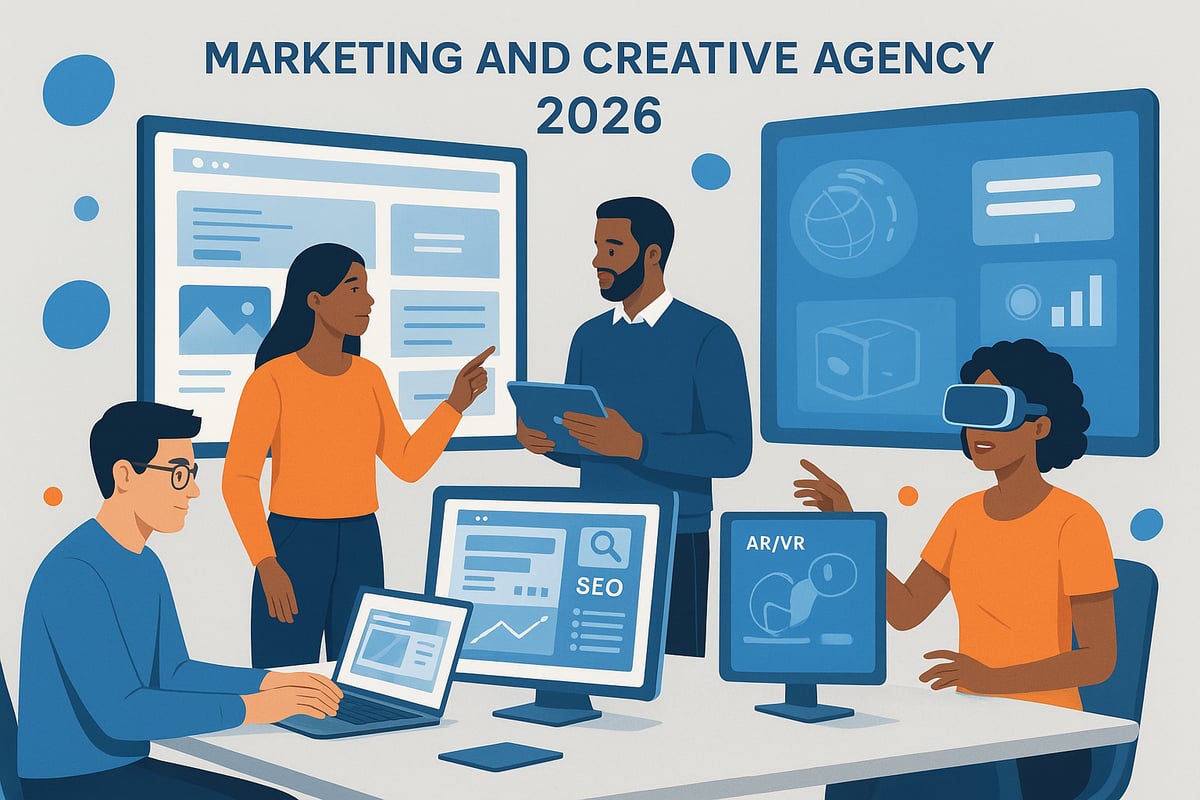
The foundation of any successful marketing and creative agency in 2026 lies in a robust suite of core services. These typically include web design, SEO, content marketing, social media management, branding, paid advertising, and data analytics. According to Search Engine Journal, 82% of agencies now prioritise SEO and content as their top service offerings.
Agencies often bundle web design with ongoing digital marketing retainers, ensuring clients benefit from cohesive, results-driven strategies. For an in-depth look at integrated offerings, see Web Design and Marketing Services. Delivering these essentials is critical for agencies seeking long-term growth and competitive differentiation.
Diversifying with Emerging Services
To remain relevant, a marketing and creative agency must embrace emerging service lines. App development, influencer marketing, AI-driven campaigns, and AR/VR experiences are increasingly vital. Agencies are moving beyond traditional marketing, supporting clients with digital transformation initiatives and customer engagement tools.
For example, integrating marketing automation and chatbots into campaigns streamlines communication and boosts efficiency. Agencies that diversify in this way are better positioned to address evolving client needs, ensuring their service portfolio remains both future-proof and comprehensive.
Service Packaging and Upselling
Marketing and creative agency success increasingly depends on the ability to package services and upsell value-added solutions. Agencies offer bundled packages tailored to specific client segments, such as “growth packages” that combine branding, web design, and digital marketing.
Bundling not only increases client retention but also raises average contract values. Clients appreciate the simplicity and synergy of all-in-one solutions, while agencies benefit from deeper, more consistent relationships. This approach is now a key differentiator in a crowded marketplace.
Partnering and White Labelling
Expanding capabilities through partnerships and white labelling is a strategic move for any marketing and creative agency. By collaborating with other agencies or skilled freelancers, agencies can offer a broader range of services without overextending internal resources.
A common example is white-labelling SEO or PPC services for partner agencies, enabling seamless delivery and brand consistency. This approach supports rapid growth, fosters innovation, and allows agencies to serve a wider variety of client needs while maintaining high standards.
Measuring and Communicating ROI & Retaining and Growing Client Relationships
Transparent reporting and clear ROI measurement are non-negotiable for any marketing and creative agency in 2026. Agencies set defined KPIs and use dashboards or custom reports to demonstrate their value to clients. Data from HubSpot shows that 70% of clients now demand transparent performance metrics.
Proactive account management, regular strategy reviews, and value-added services like quarterly audits help retain clients and grow relationships. Agencies that invest in these areas not only build trust but also secure higher lifetime client value.
Harnessing Technology and Innovation
The rapid evolution of technology is reshaping every marketing and creative agency. Staying ahead in 2026 means embracing innovation, from AI-driven workflows to immersive client experiences. Agencies that leverage these advancements not only streamline operations but also set new benchmarks for creativity and results.

AI and Automation in Creative Workflows
Artificial intelligence is now a cornerstone of every marketing and creative agency. AI-powered content creation, automated design tools, and campaign optimisation are standard. Agencies use generative AI for everything from ad copy to visual assets, reducing campaign development time by up to 40%.
For a deeper dive into this trend, see how AI is transforming marketing agencies through smarter workflows and innovative client solutions. Automation also means creative professionals can focus on strategy and ideation, enhancing the value delivered to clients.
| AI Tool | Function | Benefit |
|---|---|---|
| Copy Generators | Ad & Social Copy | Faster Turnaround |
| Design AI | Visual Assets | Consistent Branding |
| Chatbots | Client Support | 24/7 Availability |
Advanced Analytics and Attribution
A modern marketing and creative agency thrives on data. Advanced analytics platforms now offer multi-touch attribution models and predictive insights. Teams use real-time dashboards to track campaign performance, adjust strategies, and demonstrate ROI to clients.
Predictive analytics help agencies anticipate consumer trends, optimise budgets, and make smarter decisions. Data visualisation tools empower clients with clear, actionable insights, strengthening trust and satisfaction.
Martech Stack Integration
Selecting and integrating the right martech stack is essential for any marketing and creative agency in 2026. Agencies combine CRM, CMS, email, and social media tools to create seamless workflows. Interoperability is crucial, ensuring systems communicate and automate tasks efficiently.
Workflow automation can save agencies over 10 hours per week. By integrating platforms, teams reduce manual errors, speed up delivery, and improve client experiences. A well-chosen martech stack supports both creativity and operational excellence.
Privacy, Security, and Ethical Data Use
With stricter regulations and rising client expectations, every marketing and creative agency must prioritise privacy and security. Agencies are adopting privacy-first marketing strategies, investing in cybersecurity upgrades, and ensuring compliance with evolving laws.
Ethical data use is no longer optional. Transparent data practices build client trust and protect reputations. Agencies that lead in privacy are more likely to win and retain top clients.
Creative Technology: AR, VR, and Interactive Content
Immersive technology is transforming how agencies engage audiences. AR and VR enable marketing and creative agency teams to deliver interactive campaigns, from virtual product trials to branded experiences.
AR/VR ad spend is projected to reach £3.2B by 2026, reflecting client demand for innovation. Agencies that experiment with these tools unlock new storytelling possibilities and gain a competitive edge in crowded markets.
Remote Collaboration and Project Management Tools
Global teams and remote work are now standard for any marketing and creative agency. Cloud-based platforms facilitate seamless collaboration between team members and clients, regardless of location.
Project management suites streamline workflows, ensure accountability, and support 24/7 delivery. Agencies that master remote collaboration can access diverse talent pools and provide agile, round-the-clock service.
Building and Leading High-Performance Teams
A thriving marketing and creative agency in 2026 depends on the strength and cohesion of its teams. The industry’s rapid evolution demands a forward-thinking approach to talent, culture, and leadership. Agencies that prioritise their people and foster innovation stand out and achieve sustainable growth.
Talent Acquisition and Retention
Attracting and retaining top talent is a critical challenge for every marketing and creative agency. As 55% of agencies report talent shortages, firms must offer more than competitive salaries. Flexible work arrangements, clear career progression, and robust professional development programmes are essential. Agencies investing in employee wellbeing and growth create a loyal, motivated workforce, ready to meet evolving client demands.
- Flexible hours and remote options
- Skills development workshops
- Wellbeing initiatives
Fostering a Culture of Innovation
An innovative culture is the heartbeat of a leading marketing and creative agency. Encouraging experimentation, ongoing learning, and cross-disciplinary collaboration enables fresh thinking and creative breakthroughs. Agencies that reward new ideas and calculated risk-taking attract both clients and high-calibre professionals. For further inspiration on nurturing innovation, see Creative Advertising Agency Strategies.
- Open idea-sharing forums
- Recognition for creative solutions
- Cross-team projects
Diversity, Equity, and Inclusion
Building diverse teams is no longer optional for a marketing and creative agency aiming for excellence. Studies show agencies with inclusive cultures generate up to 19% higher revenue, as varied perspectives spark creativity and innovation. Commitment to equity and inclusion helps agencies better understand and serve a global client base, while also attracting top talent from all backgrounds.
- Inclusive recruitment practices
- Diversity training sessions
- Celebrating cultural events
Training and Upskilling
Continual training is essential as technology and client needs shift rapidly. Agencies that invest in upskilling their teams—especially in AI, data analytics, and creative technologies—remain competitive and agile. Internal workshops, online courses, and mentoring programmes empower staff to master new tools and methodologies, driving both personal and organisational growth.
- AI and data literacy courses
- Creative software training
- Peer-to-peer learning sessions
Remote and Hybrid Work Models
Remote and hybrid work models have become standard for the modern marketing and creative agency. Balancing flexibility with team cohesion requires clear communication, regular check-ins, and digital collaboration tools. Agencies that use virtual team-building activities and transparent workflows maintain productivity and a strong sense of belonging, regardless of location.
- Cloud-based project management
- Weekly video meetings
- Virtual social events
Leadership and Change Management
Effective leadership is crucial in guiding a marketing and creative agency through disruption and transformation. Vision-driven leaders communicate clearly, empower teams, and foster resilience. Transparent decision-making and ongoing feedback support a positive agency culture, while proactive change management ensures teams adapt smoothly to industry shifts. For more on future-ready leadership, consult Marketing Agencies in 2026: Reshaping Strategies for a New Era.
- Clear organisational vision
- Regular feedback loops
- Transparent change initiatives
Growth Strategies and Future-Proofing Your Agency
Staying ahead in the marketing and creative agency landscape demands a proactive approach to growth and resilience. Agencies that thrive in 2026 will blend structured planning, agile operations, and a readiness to evolve with the market.
Strategic Planning and Vision Setting
Every marketing and creative agency must define a clear long-term vision to remain relevant. Setting three to five-year innovation roadmaps helps agencies anticipate changes and set measurable objectives.
Regular strategy sessions, scenario planning, and stakeholder input ensure alignment and adaptability. Agencies that revisit their vision annually are better equipped to pivot and seize new opportunities, making strategic clarity a key differentiator in a crowded market.
Business Development and Lead Generation
A robust business development plan is essential for a marketing and creative agency to secure a steady pipeline. Leveraging inbound marketing, industry networking, and referral programmes can significantly boost reach.
Data shows that 60% of agencies now invest in content marketing to generate leads. Building strong relationships with prospects and nurturing them through personalised engagement helps agencies stand out and convert more opportunities.
Scaling Operations and Service Delivery
To scale successfully, a marketing and creative agency should standardise processes and embrace automation. Streamlining workflows with project management tools and outsourcing non-core tasks enables agencies to handle larger volumes without sacrificing quality.
Expanding into new markets or adding service lines may also require updating technology stacks and training teams for efficiency. Scalability relies on a balance between operational rigour and flexibility.
Client Retention and Expansion
Retaining clients is more cost-effective than acquiring new ones, so a marketing and creative agency must prioritise relationship-building. Regular check-ins, strategy reviews, and value-added services such as quarterly audits deepen trust.
Upselling and cross-selling complementary services not only increase revenue but also strengthen client loyalty. Agencies that focus on client lifetime value see up to 70% higher returns over time.
Monitoring Industry Trends and Competitors
Continuous market research and competitor analysis are vital for any agency seeking growth. Using competitive intelligence tools and subscribing to authoritative reports, such as the Creative Trends 2026, helps agencies stay ahead of emerging shifts.
Keeping abreast of trends ensures service offerings remain relevant and that agencies can pivot quickly in response to industry changes.
Preparing for Future Disruption
A future-ready marketing and creative agency invests in research, development, and scenario planning. Embracing innovation and agility allows agencies to withstand disruptions, whether from new technologies or market upheavals.
Insights from reports like Beyond Adoption: The State of AI in Creative Work 2026 illustrate how agencies are integrating AI and preparing for industry transformation. Agencies focusing on adaptability and continuous learning will remain resilient and profitable.
Having explored the latest trends, strategies, and technologies shaping the marketing and creative agency landscape in 2026, you now have a roadmap to help your business thrive in an increasingly competitive environment. Whether you are looking to elevate your brand, expand your service offerings, or simply keep pace with changing client expectations, taking the next step with expert support can make all the difference. If you are ready to put these insights into practice and see real results, why not start with a tailored solution designed for your needs? Let’s connect—get started today by requesting your Get a Quote from OxD PR.